The short answer is that using a VPN is not automatically halal or haram simply because it is a VPN.
A Virtual Private Network is a technology. It can be used to protect personal information, secure a connection on public Wi-Fi, work remotely, or reduce unnecessary online tracking. It can also be misused to access prohibited material, deceive another person or service, commit fraud, or hide harmful activity.
From an Islamic perspective, therefore, an important question is not only:
“Are VPNs halal?”
It is also:
“What am I using the VPN for?”
That distinction matters.
Islam places importance on privacy, honesty, responsibility, fulfilling agreements, avoiding harm, and staying away from prohibited activities. Those principles provide a much more useful framework for thinking about VPN use than treating the technology itself as inherently good or bad.
This article explores those principles without pretending to issue a personal fatwa. For individual circumstances—particularly questions involving local law, contracts, financial transactions, or disputed religious rulings—a qualified Islamic scholar should be consulted.
What Is a VPN and What Does It Actually Do?
A VPN, or Virtual Private Network, creates an encrypted connection between your device and a VPN server.
Instead of connecting directly to an online service using your normal public IP address, your traffic first travels through the VPN connection.
In practical terms, a VPN can help:
- conceal your normal public IP address from websites;
- encrypt traffic between your device and the VPN server;
- reduce what people on the same local network can observe;
- provide additional protection when using public Wi-Fi;
- securely connect employees to company systems;
- make certain forms of online tracking more difficult.
Mozilla describes a VPN as creating an encrypted tunnel between a device and a VPN server while allowing the user to appear online through the server’s IP address. Cloudflare similarly describes VPNs as internet-security tools commonly used for privacy, public Wi-Fi protection, remote work and other legitimate purposes.
However, a VPN should not be confused with complete anonymity.
It does not suddenly make everything a person does online invisible or safe. You still need secure passwords, updated software, careful browsing habits and trustworthy online services.
Even security authorities such as CISA warn organisations that VPN and remote-access systems need to be configured and managed correctly because poorly configured systems can introduce their own risks.
So before asking whether a VPN is halal, it helps to understand what the technology really is: a privacy and networking tool—not a moral decision by itself.
Is Using a VPN Haram in Islam?
It would be misleading to say that every use of a VPN is haram.
It would be equally misleading to say that everything done through a VPN becomes permissible simply because the connection is private.
A more responsible way to examine the issue is to consider the purpose, method and consequences of the use.
The well-known hadith narrated from Umar ibn al-Khattab states that actions are judged according to intentions.
That does not mean intention is the only consideration in Islamic law. A good intention does not make an otherwise prohibited action permissible.
But intention does matter when evaluating why a person is using a technology.
Consider two people opening the same VPN application.
One is sitting in an airport and uses it to protect confidential business information on public Wi-Fi.
The other deliberately uses it to hide fraudulent activity.
Technically, both people are using exactly the same type of software.
Ethically, they are doing very different things.
That is why the question “Is VPN halal or haram?” cannot always be answered responsibly without asking what the VPN is being used to accomplish.
Privacy Is Not the Same as Having Something to Hide
People sometimes treat privacy as suspicious:
“If you have nothing to hide, why would you need a VPN?”
That argument misunderstands privacy.
A person may close the curtains at home without committing a crime. A business may protect customer records without hiding wrongdoing. A parent may not want a child’s online activity exposed to advertisers or unknown third parties.
Digital privacy works in a similar way.
The Qur’an explicitly warns believers against spying on one another:
“And do not spy…”
— Qur’an 49:12
The verse appears in a wider discussion about suspicion, spying and backbiting. Classical commentary on the verse discusses the prohibition of searching into people’s hidden affairs and faults without justification.
A VPN obviously did not exist when this verse was revealed, so it would be wrong to claim that the verse directly commands Muslims to use VPN software.
What the verse does demonstrate is that privacy and protection from unjustified intrusion are not foreign concepts in Islamic ethics.
In the digital world, protecting personal information can therefore be a legitimate concern.
When Can a VPN Serve a Legitimate Purpose for Muslims?
There are many ordinary situations where someone might use a VPN without trying to bypass moral boundaries.
Protecting Yourself on Public Wi-Fi
Imagine connecting to Wi-Fi at an airport, hotel, university or coffee shop.
You may be checking email, accessing a work account or signing into another service containing personal information.
A VPN can add an encrypted layer between your device and the VPN server, reducing exposure to other parties on the local network.
Using privacy technology to protect legitimate personal or professional information is very different from using privacy technology to conceal wrongdoing.
Working Remotely
Businesses have used VPN technologies for years to allow employees to access internal company systems remotely.
A Muslim accountant accessing company files from home, a developer connecting securely to a corporate network, or an employee protecting confidential customer data is not using a VPN primarily to evade Islamic boundaries.
The VPN is simply part of their cybersecurity infrastructure.
Protecting Personal Information
Modern online activity can reveal information about location, devices, browsing behaviour and other digital habits.
The FTC encourages internet users to think carefully about privacy settings, location sharing and the personal information they expose online.
Taking reasonable steps to protect personal information can therefore be part of responsible internet use.
Protecting a Family’s Digital Environment
For Muslim parents, online safety involves more than hiding an IP address.
Parents may also care about:
- explicit content;
- pornography;
- gambling;
- harmful advertising;
- inappropriate recommendations;
- unsafe online interactions;
- excessive screen time;
- privacy risks affecting children.
A traditional VPN alone does not solve these problems.
This is where the idea of a Muslim VPN or faith-aligned internet safety solution becomes different from an ordinary privacy VPN.
A privacy tool protects the connection.
A family-oriented system may also introduce filtering, parental controls and safer browsing tools intended to reduce exposure to harmful content.
When Can Using a VPN Become Islamically Problematic?
The fact that privacy is valuable does not mean privacy technology has no ethical limits.
There are several situations where the problem is not the VPN itself but what the person is doing through it.
1. Using a VPN to Access Haram Content
If someone intentionally uses a VPN to bypass restrictions specifically so they can access pornography, gambling platforms or other clearly prohibited material, the privacy technology does not change the nature of the underlying activity.
The VPN is simply being used as a route to reach something the person already knows they should avoid.
An Islamic ruling published by IslamWeb makes a similar distinction: bypass technology was not treated as inherently prohibited, but its acceptability depended on the content being accessed, the rights of others and legitimate rules being respected.
This illustrates why purpose matters more than the VPN label itself.
2. Using a VPN for Fraud or Financial Deception
Changing an apparent online location does not make deception acceptable.
Examples could include intentionally pretending to live somewhere else in order to obtain a financial benefit one is not entitled to, creating fraudulent accounts, stealing another person’s information or hiding financial crime.
The Qur’an tells believers not to consume one another’s wealth unjustly and instead recognises lawful exchange based on mutual consent.
Privacy should protect people from wrongdoing.
It should not become a shield for committing wrongdoing against others.
3. Using a VPN to Break Agreements Dishonestly
One of the more difficult modern questions involves using a VPN to bypass regional restrictions imposed by streaming services, subscription providers, employers or online platforms.
There is no single technical answer to this question because situations differ.
The Qur’an instructs believers to fulfil agreements and obligations.
Therefore, before deliberately bypassing a restriction, it is worth checking:
- What did I agree to?
- Am I misrepresenting myself?
- Am I obtaining something I have no right to receive?
- Am I violating someone’s rights?
- Is there a specific local law involved?
- Is this simply a technical routing choice, or am I using it to deceive another party?
Contractual questions can become complicated, so a qualified scholar should be consulted where the answer affects an important religious decision.
What About Using a VPN to Access Blocked Websites?
This is one of the most searched questions surrounding VPNs and Islam.
Again, “blocked” does not always mean the same thing.
A website might be restricted because it contains pornography or illegal material.
Another may be inaccessible because of a company network policy.
Another may be unavailable because of licensing.
Another may involve news, communications, work resources or information restricted under a particular country’s laws.
Those situations should not automatically receive one identical religious judgment.
An Islamic ruling addressing VPN-like bypass networks noted that using such technology was not inherently wrong when the destination itself was permissible, no rights were being violated and legitimate public-interest rules were not being broken.
Local laws also differ between countries and can change.
A Muslim should therefore consider both Islamic responsibility and applicable law instead of assuming that a VPN gives unlimited permission to bypass every restriction.
Didn’t Islamic Scholars Say VPNs Are Haram?
You may have encountered headlines claiming that “VPNs are haram.”
Those headlines often leave out important context.
For example, a public debate occurred in Pakistan in November 2024 after comments from the Council of Islamic Ideology regarding VPN use. Initial reporting described VPN use for blocked or unethical content as contrary to Islamic principles. Later clarification emphasised that the technology itself was not universally being declared haram; concern centred on its use for indecent, illegal or otherwise prohibited activity.
That distinction is important.
“VPN technology is haram” and “using a VPN to facilitate haram activity is wrong” are not the same statement.
Users should also be careful with dramatic social-media posts that turn nuanced religious discussions into absolute claims.
For a religious question, look for:
- the scholar’s complete statement;
- its context;
- the evidence being used;
- whether the ruling concerns the technology itself or a particular use;
- whether the issue involves a country’s law or regulatory policy;
- whether qualified scholars disagree.
This is especially important when the original question has been reduced to a viral headline.
Does Islam Encourage Online Privacy?
Islam does not teach that people should live completely hidden from one another.
Nor does it teach that everyone has unlimited permission to investigate the private affairs of others.
Islamic teachings around suspicion, spying, dignity, trust, honesty and responsibility create a broader ethical framework in which privacy has genuine value.
Qur’an 49:12’s prohibition against spying is particularly relevant when thinking about digital behaviour.
However, privacy also comes with responsibility.
A useful principle for the modern internet is:
Protect privacy without using privacy as an excuse to harm others.
That balance matters when selecting and using any security technology.
A VPN Does Not Make Haram Content Halal
This may sound obvious, but it is worth stating clearly.
Technology changes how content reaches your device.
It does not automatically change what that content is.
If a person uses:
- private browsing,
- a VPN,
- encrypted messaging,
- a proxy,
- a private DNS service,
- or another privacy technology,
the ethical status of the underlying behaviour still deserves consideration.
Privacy can protect dignity.
Encryption can protect data.
Security tools can protect families.
But none of them should be treated as a religious loophole.
What Should Muslims Look for in a VPN?
For Muslims concerned about both cybersecurity and responsible internet use, choosing a VPN should involve more than comparing server numbers.
A Clear Privacy Policy
Read what information the service collects.
Look for explanations covering:
- account information;
- connection information;
- activity logs;
- analytics;
- third-party sharing;
- data retention;
- account deletion.
Avoid relying only on a marketing statement such as “100% private.”
Privacy claims should be supported by clear documentation.
Strong Security
Look for reputable encryption and modern VPN protocols.
Remember that a VPN is only one layer of security.
You still need strong passwords, multi-factor authentication, updated devices and secure websites.
Transparency
A trustworthy provider should explain what its technology can and cannot do.
Claims such as “complete anonymity” should be treated carefully.
A VPN can improve privacy, but no responsible cybersecurity tool should promise that a user becomes magically invisible online.
Family Protection Where Needed
Parents may want additional controls such as:
- inappropriate-content filtering;
- family-safe modes;
- age-appropriate settings;
- time controls;
- category blocking;
- clear parental controls.
An ordinary VPN usually focuses primarily on connection privacy.
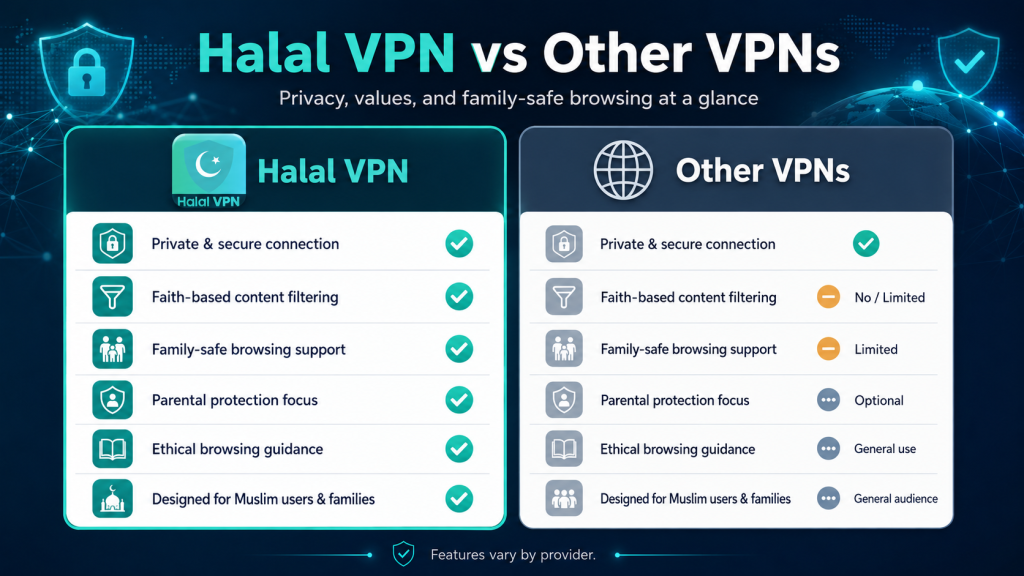
A Halal VPN or Muslim VPN solution may aim to combine privacy with tools designed around a Muslim family’s digital values.
Ethical Design
Ask whether the service’s business model respects users.
A company describing itself as faith-aligned should be especially transparent about data collection, advertising, tracking and children’s privacy.
Faith-based branding should increase the responsibility to demonstrate trust—not replace the need for evidence.
Halal VPN vs Regular VPN: What Is the Difference?
A regular VPN mainly answers a technical question:
“How can I make my internet connection more private and secure?”
A Halal VPN attempts to answer an additional question:
“How can technology also help me use the internet in a way that supports my values?”
That may involve combining VPN protection with features such as:
- halal-content filtering;
- blocking of explicit websites;
- parental controls;
- family-safe browsing;
- privacy protection;
- tools that help users manage digital habits.
That does not mean software can make every religious decision for a person.
Technology can reduce exposure and create boundaries.
It cannot replace taqwa, judgment, parenting, education or personal responsibility.
A filter is a tool.
The user’s choices still matter.
For a deeper explanation of faith-aligned VPN technology, read our guide to Halal VPN & Muslim VPN Solutions.
Can Muslim Parents Use a VPN for Their Children?
Yes, privacy technology can form part of a family’s online-safety strategy, but a standard VPN alone is not enough.
Children face risks that encryption does not solve.
A VPN may protect traffic while doing nothing to prevent a child from opening explicit content after the VPN connection is established.
Parents should think in layers:
Privacy: Who can observe the connection?
Security: Is the device protected?
Content: What is accessible?
Behaviour: How is the child actually using the internet?
Education: Does the child understand why certain boundaries exist?
The strongest digital-safety approach combines appropriate technology with conversation, trust and age-appropriate supervision.
The goal should not be to secretly watch every movement of a child.
It should be to build a safer digital environment while gradually teaching responsible independence.
So, Is Using a VPN Halal?
For most people, the better answer is:
A VPN is a tool. Its Islamic implications depend largely on what it is being used for and whether the use involves something prohibited, dishonest, harmful or unlawful.
Using a VPN for legitimate privacy, cybersecurity, remote work or protection on public networks is very different from using one to facilitate pornography, fraud, theft or deliberate wrongdoing.
Before turning on a VPN, a Muslim can ask four simple questions:
- Why am I using it?
- What am I trying to access or protect?
- Am I harming or deceiving anyone?
- Does the activity itself comply with my religious and legal responsibilities?
Those questions provide a much more meaningful answer than simply asking whether the VPN icon on your phone is halal or haram.
Final Thoughts: Privacy With Responsibility
Islamic ethics and modern privacy technology do not have to be treated as opposing ideas.
Protecting personal information can be responsible.
Securing family devices can be responsible.
Encrypting confidential work can be responsible.
Reducing unnecessary tracking can be responsible.
At the same time, privacy should never become an excuse for dishonesty, exploitation or knowingly accessing what a person believes to be prohibited.
The most useful question is therefore not simply:
“Is a VPN halal?”
It is:
“Am I using this technology in a way that protects me without compromising my responsibilities to Allah, myself and other people?”
That is the conversation worth having.
Frequently Asked Questions
Is VPN halal in Islam?
VPN technology itself should not automatically be labelled halal or haram without considering how it is being used. Legitimate privacy and security uses differ fundamentally from using a VPN to facilitate prohibited or harmful behaviour. For an individual religious ruling, consult a qualified scholar.
Is it haram to hide your IP address?
Hiding an IP address for privacy or cybersecurity is not the same as hiding criminal or prohibited activity. The reason for hiding it and what the user subsequently does are important considerations.
Can Muslims use a VPN for privacy?
A VPN can be used as one part of a privacy strategy. Islamic teachings include strong concerns around unjustified spying and intrusion into private affairs, although those teachings should not be misunderstood as granting permission to conceal wrongdoing. Qur’an 49:12 is particularly relevant to the broader principle of avoiding spying.
Is using a VPN to watch another country’s Netflix halal?
This question can involve subscription terms, licensing agreements and potentially local laws. Users should first review the agreement they accepted and avoid dishonest misrepresentation. If the contractual question is religiously important to you, seek advice from a qualified scholar.
Is using a VPN to access pornography haram?
A VPN does not change the nature of the content being accessed. Using privacy technology to reach material that is already religiously prohibited does not make that material permissible.
Is a free VPN safe?
Not necessarily. Price alone does not determine security. Users should examine the provider’s privacy policy, logging practices, security protocols, ownership and data-sharing practices. Some poorly designed VPN products may introduce privacy or security risks.
Does a VPN provide complete anonymity?
No. A VPN can conceal your normal public IP address from websites and encrypt traffic between your device and the VPN server, but it should not be treated as a guarantee of total anonymity. Accounts, cookies, device information and other technologies can still identify or profile users.
What is a Muslim VPN?
A Muslim VPN generally refers to a VPN or digital-safety service designed with Muslim users and families in mind. In addition to privacy and security, it may offer filtering or parental-control tools intended to reduce exposure to explicit or otherwise inappropriate content.
Editorial & Religious Review Note
This article discusses general Islamic ethical principles and cybersecurity concepts for educational purposes. It is not a fatwa and should not replace advice from a qualified Islamic scholar regarding an individual’s specific circumstances. Before publication, religious statements should ideally be reviewed by a suitably qualified scholar, particularly where the article represents a faith-based technology brand.