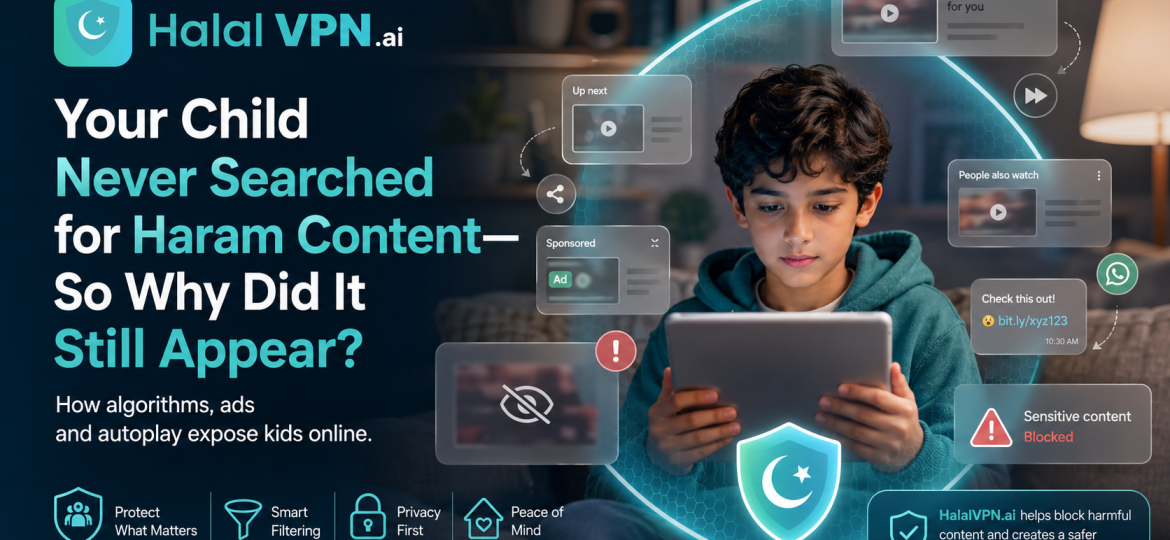
A child opens YouTube to watch a science video.
They do not search for anything inappropriate.
A few videos later, an uncomfortable thumbnail appears.
Later, they open TikTok. Another video appears in the For You feed that contains language, clothing, behaviour or themes the family would rather they did not see.
Then an advertisement appears inside a game.
A friend sends a link.
A video starts automatically.
The child never typed an inappropriate search.
So how did the content reach them?
This is one of the biggest misunderstandings in modern parental controls:
Children no longer have to search for harmful or haram content to encounter it.
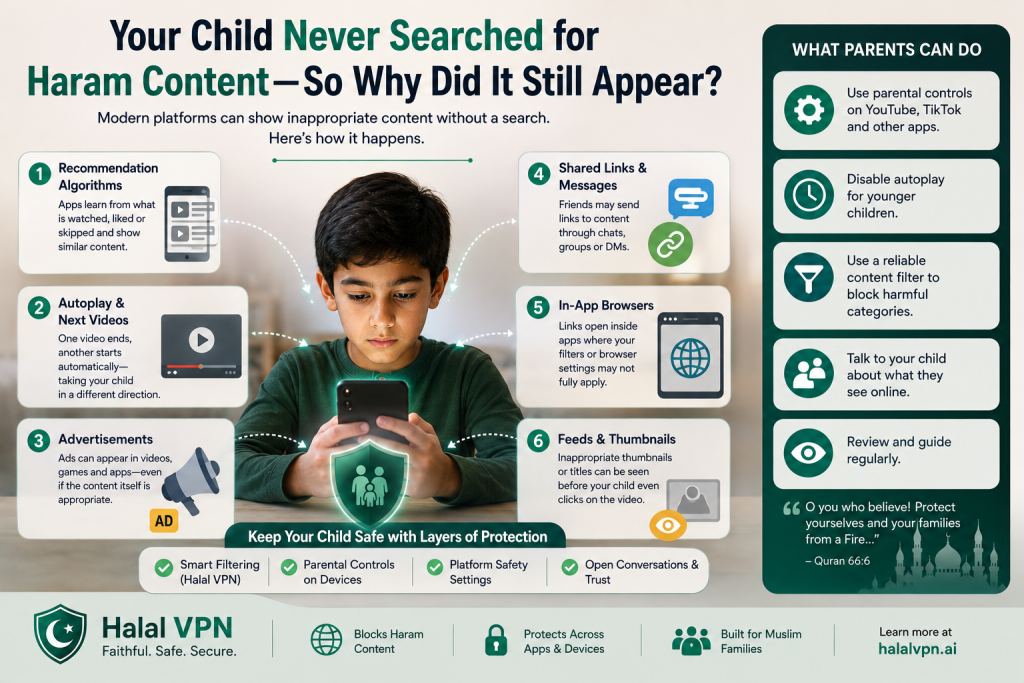
Personalised recommendation systems, advertising, autoplay, social sharing and algorithmic feeds can bring content directly to users.
That is not just a theoretical concern. Ofcom reported in 2026 that nearly three-quarters of UK children aged 11–17 had encountered harmful content online during a four-week period. Among children who encountered such material, personalised feeds were a major pathway: 35% recalled seeing harmful content while simply scrolling their feed.
For Muslim parents, this creates a new challenge.
Traditional thinking often focuses on:
“Which websites should I block?”
The modern question is broader:
“What can reach my child even when they never intentionally look for it?”
That is why modern Haram Content Blocking & Filtering needs to think beyond website blacklists and consider recommendations, apps, advertisements, shared links, videos and the wider digital environment. HalalVPN’s own filtering framework recognizes that inappropriate material can appear through search results, advertising, games, social platforms, shared links and unfamiliar sites.
Searching for Content and Being Exposed to Content Are Not the Same Thing
Imagine two situations.
Situation One
A teenager deliberately searches for:
“online gambling site.”
The intent is relatively easy to understand.
A parental-control system may recognize the domain or category and block access.
Situation Two
The same teenager watches a football highlights video.
The next video includes sports-betting sponsorship.
Then an advertisement promotes a betting platform.
Later, an influencer casually discusses gambling.
The teenager never searched for gambling.
But gambling-related content still entered the experience.
This difference matters.
Traditional content filtering was often designed around requests:
- The user enters a website.
- The system checks it.
- The system allows or blocks it.
Modern platforms increasingly operate around recommendations:
- The user opens an app.
- The platform studies available signals.
- Algorithms select what appears next.
- The user reacts to it.
- Those reactions influence future recommendations.
The child does not necessarily choose the next piece of content.
Sometimes the algorithm does.
How Recommendation Algorithms Decide What Children See
Recommendation systems are designed to predict what a user may want to watch, read or interact with next.
TikTok publicly explains that its recommendation systems consider signals including content a user likes, shares, comments on, watches fully or skips, along with information about the content itself.
YouTube similarly explains that watch and search history can influence recommendations. Users can pause these histories when they do not want previous activity affecting future recommendations.
That creates a feedback loop.
A child watches something.
The system learns from it.
The system recommends something similar.
The child watches again.
The system receives another signal.
Over time, a feed can become increasingly personalized.
Usually this is designed to make services more relevant and enjoyable.
But personalization also creates a safety challenge.
A child may become exposed to content they never consciously asked to see.
UNICEF notes that AI-driven systems increasingly shape children’s online experiences by recommending videos, articles, music and even people to connect with.
1. The “One Innocent Video” Problem
One of the easiest ways inappropriate content can appear is through related recommendations.
Suppose your child enjoys football.
They watch:
“Best Goals of the Season.”
The next recommendation might be:
“Football Players’ Luxury Lifestyles.”
Then:
“Inside Footballers’ Parties.”
Then another video may introduce sexualized thumbnails, gambling sponsorships, inappropriate music or mature themes.
The original search was harmless.
The journey changed.
This does not mean recommendation algorithms intentionally lead children toward haram content.
It means recommendation systems optimize around signals and predicted interest rather than a Muslim family’s individual religious standards.
That distinction matters.
Watch History Can Shape What Comes Next
YouTube states that watch history helps it provide relevant recommendations.
For parents using supervised YouTube accounts, Google provides additional controls. Parents can select content settings and can disable autoplay. Google also allows parents to pause watch history so that new views are not used as signals for future recommendations.
These controls are worth using.
But parents should understand why they exist:
what a child watches today can influence what they are shown tomorrow.
2. TikTok’s For You Feed Does Not Wait for a Search
TikTok makes this problem even easier to understand.
The main experience is called For You.
TikTok explains that the feed recommends content based on several factors, including whether users watched similar posts, liked them, commented on them or shared them.
A child can therefore spend considerable time on TikTok without entering a traditional search query.
They open the app.
The feed begins.
Scroll.
Scroll.
Scroll.
Each swipe reveals content selected for them.
From a parental perspective, this changes the safety question from:
“What is my child searching for?”
to:
“What is the algorithm placing in front of my child?”
Ofcom now describes personalised feeds as a significant route through which children encounter harmful material online.
Small Interactions Can Affect Future Recommendations
A teenager does not always have to press the Like button to influence a feed.
TikTok says recommendation signals can include whether content is watched fully or skipped, as well as likes, shares and comments.
So imagine that an inappropriate video appears.
The child is surprised and watches it to the end.
Perhaps they are confused.
Perhaps they are curious.
Perhaps they simply froze for a moment.
The platform may still receive an engagement signal.
That can contribute to future recommendations.
This is one reason parents should avoid assuming:
“If it appeared repeatedly, my child must have searched for it.”
That conclusion may be wrong.
3. Autoplay Can Continue the Journey Without Another Click
Recommendation systems are not the only issue.
Autoplay matters too.
On YouTube, autoplay can automatically begin another video after the current one finishes. Google provides controls for turning this feature off, including parental options for supervised children’s accounts.
Consider what that means practically.
Your child deliberately chooses one appropriate video.
When it finishes, another starts.
Then another.
Thirty minutes later, the viewing session may have moved considerably away from the original topic.
The child did not search for each video.
They may not even have intentionally selected each one.
For younger children particularly, disabling autoplay can reduce the number of algorithm-selected transitions.
4. Ads Can Introduce Content Parents Never Approved
Parents often focus on the main content while forgetting advertising.
But ads are also part of the online environment.
A child may be using:
- a free mobile game;
- a video platform;
- a website;
- a social app;
- a streaming service.
The primary content may be acceptable.
The advertisement may not be.
UNICEF advises parents to be aware that children can encounter advertising that promotes age-inappropriate material or other potentially problematic messages.
For Muslim families, advertising can create additional concerns.
Parents may want to reduce exposure to promotions involving:
- gambling;
- alcohol;
- dating;
- sexualized imagery;
- inappropriate entertainment;
- misleading products;
- scams.
The child never asked for the ad.
It was inserted into their experience.
That is why filtering only what a child searches for leaves an important gap.
5. Social Sharing Can Bypass the Search Process Completely
Another major pathway is other people.
A child does not need to find a video.
A friend can send it.
A classmate can share a link.
Someone can post it in a group conversation.
A creator can repost something.
A message can contain an external website.
The child simply taps.
Again, no search was required.
HalalVPN’s Haram Content Blocking & Filtering cluster specifically identifies shared links and social-media exposure among the routes through which inappropriate material may reach families.
This is where broader filtering can be useful.
If the shared link leads to a clearly inappropriate or blocked domain, network- or device-level protection may still prevent access even though the child did not discover the site through Google.
6. In-App Browsers Can Create Another Path
Suppose someone sends your child a link through a social app.
The child taps it.
Chrome never appears.
Safari never appears.
Instead, the webpage opens inside the social-media application.
This is an in-app browser.
To the child, it feels like ordinary internet browsing.
From a parental-control perspective, however, different apps and operating systems can handle embedded web content differently.
This means parents should not automatically assume:
“I configured Chrome, therefore every link on the phone is protected in exactly the same way.”
The safer approach is to test the apps your child actually uses.
7. Thumbnails Can Expose Children Before a Video Even Starts
Sometimes the child does not even need to open the content.
Think about a video feed.
Before the child decides whether to watch, they may already see:
- thumbnails;
- titles;
- profile pictures;
- captions;
- preview images.
A parent may successfully prevent the child from opening a mature video while the thumbnail itself has already exposed them to something inappropriate.
This is one reason content moderation at the platform level matters alongside website filtering.
Network-level systems are very useful for controlling access to entire services and categories.
They cannot always understand every individual image displayed inside an encrypted third-party platform.
8. Comments Can Change an Otherwise Safe Experience
Consider an educational video.
The video itself is completely appropriate.
Underneath it are comments.
Those comments may contain:
- profanity;
- sexual references;
- links;
- harassment;
- scams;
- invitations to other platforms.
Again, the parent chose appropriate content.
The unwanted material existed around it.
This illustrates why modern online protection should consider the whole experience, not only the main video or webpage.
9. Live Content Creates a Different Type of Risk
Recorded videos can be reviewed and classified.
Live content is different because it is happening in real time.
A livestream can change direction unexpectedly.
A conversation can become inappropriate.
A comment can appear instantly.
A guest can join.
That makes live environments particularly difficult to filter perfectly.
Platform safety systems remain important, but parents should use age-appropriate restrictions rather than assuming automated filtering can pre-screen everything that has not happened yet.
10. AI Can Generate Content That Never Existed Before
The next challenge is even more significant.
Traditional content filters generally classify existing material.
AI systems can generate something new.
A child asks a question.
The chatbot generates an answer immediately.
That exact answer may never have existed online before.
This creates a fundamentally different filtering challenge.
UNICEF notes that AI is becoming increasingly embedded in children’s lives through chatbots, learning apps, games and other services, while AI-driven systems also influence the information and interactions children encounter.
A blacklist cannot contain every future AI-generated sentence.
This is why AI safety increasingly requires safeguards inside the AI platform, in addition to broader network and device protection.
So Does This Mean Content Filters Are Useless?
No.
It means we need to stop expecting one filter to solve every layer of the problem.
A good content filter remains extremely valuable.
For example, it can help prevent access to known categories of websites associated with:
- adult material;
- gambling;
- intoxicants;
- phishing;
- scams;
- malware.
HalalVPN’s Haram Content Blocking & Filtering framework is built around filtering these kinds of categories while also supporting trusted allowlists and family-focused controls.
The mistake is not using content filtering.
The mistake is assuming:
“I installed a filter, therefore every piece of content inside every app is now guaranteed safe.”
No responsible safety system can make that promise.
Traditional Filters Were Built for an Earlier Internet
A traditional filtering model often looks like this:
Website requested → category checked → allow or block.
That model still works well for many clearly categorized websites.
The problem is that modern children spend much of their digital lives inside services that contain enormous mixtures of content.
For example:
YouTube
Educational lectures and inappropriate entertainment exist under the same domain.
TikTok
Useful educational clips and unwanted videos can appear in the same feed.
Family photos, businesses, religious reminders and inappropriate imagery can all exist inside one platform.
AI Chatbots
The same tool can explain mathematics, help with homework or participate in conversations parents may consider unsuitable.
The question has therefore shifted from:
“Is this website good or bad?”
to:
“What is happening inside this digital environment right now?”
Why AI-Powered Haram Filtering Has an Important Role
This is where intelligent classification becomes valuable.
A basic keyword filter may see the word:
gambling
and block it.
But consider these three pieces of content:
Example A
“Join our casino and get a £100 betting bonus.”
Example B
“New research examines gambling addiction among teenagers.”
Example C
“Why is gambling prohibited in Islam?”
All contain the same word.
But their purpose is completely different.
A useful AI-assisted system should aim to consider signals such as:
- category;
- context;
- meaning;
- intent;
- surrounding content.
That is more sophisticated than matching individual words.
HalalVPN describes its filtering approach as using intelligent classification around categories relevant to Muslim families rather than relying exclusively on basic website blocking.
However, AI filtering should never be presented as perfect.
Context is difficult.
Mistakes can still happen.
The responsible goal is better protection, not an impossible promise of zero exposure.
Mainstream “Safe” and “Right for Our Family” Are Not Always Identical
Another issue Muslim parents face is the difference between platform rules and family standards.
A social-media platform might decide that a particular video:
- does not contain nudity;
- is not age-restricted;
- does not violate community guidelines.
Therefore, the platform permits it.
A Muslim family may still consider the video inappropriate because of:
- sexualized presentation;
- gambling promotion;
- alcohol;
- immodest imagery;
- language;
- behaviour being normalized;
- another family-specific Islamic concern.
Neither system is necessarily answering the same question.
The platform asks:
“Does this content violate our general policy?”
The family asks:
“Does this fit the values we want for our children?”
A faith-aware filtering system attempts to address that second layer.
What Parents Can Actually Do
Parents do not need to understand recommendation-system engineering.
They need a practical strategy.
1. Use Network-Level Filtering
Start with broad protection against clearly inappropriate website categories.
For Muslim families, this can include the protections described in HalalVPN’s Haram Content Blocking & Filtering for Muslim Families cluster page.
This creates a foundation.
2. Configure YouTube Separately
If your child uses YouTube, do not rely only on SafeSearch or network filtering.
For younger children, consider supervised YouTube accounts or YouTube Kids. Google allows parents to select content levels for supervised children’s accounts.
Parents can also consider:
- disabling autoplay;
- pausing watch history;
- blocking specific channels;
- reviewing recommendation settings.
Google provides these controls for supervised experiences.
3. Configure TikTok Separately
For teenagers who use TikTok, use its own family controls.
TikTok’s Family Pairing allows parents and guardians to manage multiple safety settings, while Restricted Mode is designed to reduce exposure to content that may not be suitable for everyone.
Parents should also understand how the For You feed works so they can explain it to their children.
4. Teach Children to Use “Not Interested”
Children should understand that their behaviour teaches recommendation systems.
TikTok provides tools to influence recommendations, including feed-management and topic controls.
When inappropriate material appears, children can learn to:
- scroll away quickly;
- avoid engaging;
- choose “Not interested” where available;
- block problematic accounts;
- report clearly harmful content.
This gives children some control over what algorithms learn about them.
5. Turn Off Autoplay for Younger Children
Autoplay creates more algorithm-selected transitions.
Google allows parents managing supervised YouTube accounts to disable autoplay.
For younger children, this is a simple change worth considering.
Instead of one video automatically leading into another, the child has to stop and make another choice.
That small pause can be valuable.
6. Review Apps, Not Just Browsing History
Ask:
Which apps does my child spend time in?
Then review the safety settings inside those apps.
UNICEF recommends that parents check children’s devices, platform privacy settings and parental controls regularly because apps and their features continue to evolve.
7. Talk About Accidental Exposure Before It Happens
A child should know:
“If something inappropriate suddenly appears, you are not automatically in trouble.”
This matters.
If children think accidental exposure will result in anger or punishment, they may hide it.
Instead, teach a simple response:
Close it. Move away. Tell us if you’re worried.
UNICEF similarly encourages parents to maintain communication so children feel able to seek help when an online experience feels wrong or uncomfortable.
Don’t Punish a Recommendation as Though It Were a Search
This may be one of the most important parenting lessons in this article.
Imagine checking your child’s YouTube screen and finding an inappropriate recommendation.
There are at least two possible explanations.
Explanation 1
Your child deliberately searched for similar content repeatedly.
Explanation 2
The algorithm recommended something unexpected.
Those require different conversations.
Before reacting, ask:
“How did this appear?”
Not:
“Why were you searching for this?”
That one change in wording can make it much easier to understand what actually happened.
Look at the Feed Together
Parents can learn a surprising amount by occasionally asking:
“Show me what your YouTube or TikTok feed looks like.”
Not secretly.
Together.
Look at:
- recommended videos;
- ads;
- Shorts;
- For You content;
- creators appearing repeatedly;
- suggested topics.
Then ask:
“Why do you think the app keeps showing you this?”
This turns parental control into digital education.
Over time, children begin understanding that feeds are not random.
They are engineered recommendation environments.
That knowledge becomes another safety layer.
The 10-Minute Recommendation Safety Audit
Once every few weeks, review these areas:
Google and Search
- Is SafeSearch enabled where appropriate?
- Is the child using the correct supervised account?
YouTube
- Is the correct content level selected?
- Is autoplay necessary?
- Is watch history influencing recommendations?
- Are problematic channels appearing repeatedly?
TikTok
- Is Family Pairing configured?
- Is Restricted Mode appropriate?
- What topics dominate the For You feed?
- Are unwanted accounts or topics being blocked?
Apps
- Have any new social or video apps appeared?
- Are games displaying advertisements?
- Do apps contain embedded browsers?
AI
- Which AI tools does your child use?
- Are they age appropriate?
- What safeguards does the provider offer?
Family
Ask:
“Has anything weird, uncomfortable or inappropriate appeared online recently?”
That final question may reveal more than every setting combined.
Where HalalVPN Fits Into This Problem
The purpose of a halal internet solution should not be to promise that algorithms will suddenly disappear.
They will not.
Nor should a Muslim VPN claim it can perfectly read every encrypted video, private message or third-party recommendation.
A more realistic role is to provide another layer of control.
HalalVPN’s Haram Content Blocking & Filtering approach focuses on helping families restrict categories including adult material, gambling, intoxicants, scams, phishing and other unwanted content while also supporting trusted access.
Used alongside:
- device parental controls;
- supervised accounts;
- YouTube controls;
- TikTok Family Pairing;
- app restrictions;
- family conversations;
that filtering layer becomes part of a much stronger system.
The important word is layer.
Not replacement.
Frequently Asked Questions
Why is inappropriate content appearing if my child never searched for it?
Modern platforms use recommendation systems, autoplay, advertising and social sharing. TikTok, for example, says its recommendation system considers signals including watched, skipped, liked, shared and commented-on content. YouTube also uses watch and search activity to help shape recommendations.
Can TikTok recommend inappropriate content without a child searching for it?
Content on TikTok’s For You feed is recommended algorithmically rather than requiring a search for every video. TikTok says recommendations are influenced by user interactions and content information.
Can YouTube recommendations be controlled for children?
Parents using supervised children’s accounts have several controls, including content settings and the ability to disable autoplay. They can also pause watch history so new views do not influence future recommendations.
Does Google SafeSearch stop inappropriate TikTok or YouTube recommendations?
SafeSearch is primarily intended to filter explicit results within Google Search. YouTube and TikTok have separate recommendation and parental-control systems, so parents should configure those platforms individually.
Can haram content appear through advertisements?
Yes. Advertising can expose children to messages or material they did not deliberately search for. UNICEF specifically advises parents to help children recognize online ads and notes that advertising may contain age-inappropriate or otherwise harmful messaging.
Does a halal content filter stop every inappropriate recommendation?
No responsible filter should promise 100% protection inside every third-party platform. Network filtering, device controls and individual platform safeguards work at different levels. Using them together provides stronger protection than relying on one tool.
What should my child do if inappropriate content suddenly appears?
Encourage them to move away from the content, avoid engaging with it, use “Not interested,” block or report where appropriate, and speak to a trusted parent or caregiver if the content worries them. UNICEF recommends maintaining communication so children feel comfortable seeking help after negative online experiences.
Final Thoughts: Sometimes the Content Finds the Child
The biggest shift in online safety is simple:
Children no longer have to find everything they see.
Algorithms recommend.
Videos autoplay.
Friends share.
Ads appear.
Feeds refresh.
Links open.
AI generates.
That means checking Google search history is no longer enough to understand a child’s digital environment.
And it means finding inappropriate content on a child’s screen does not automatically prove that they deliberately searched for it.
Modern family protection needs to focus on both:
intentional access
and
unexpected exposure.
For Muslim families, the strongest approach is layered:
Haram content filtering + device protection + platform controls + age-appropriate supervision + open conversations + Islamic digital values.
Technology can reduce exposure.
Parents can provide guidance.
And children can gradually learn how to respond when an algorithm puts something in front of them that they never asked to see.
Because today, the question is no longer only:
“What is my child searching for?”
It is also:
“What is the internet choosing to show them?”