For years, online filtering seemed relatively simple.
A parent blocked adult websites, enabled SafeSearch, added a few restricted categories, and assumed the biggest risks had been covered.
That model made sense when most internet activity happened through a web browser.
But children do not use the internet that way anymore.
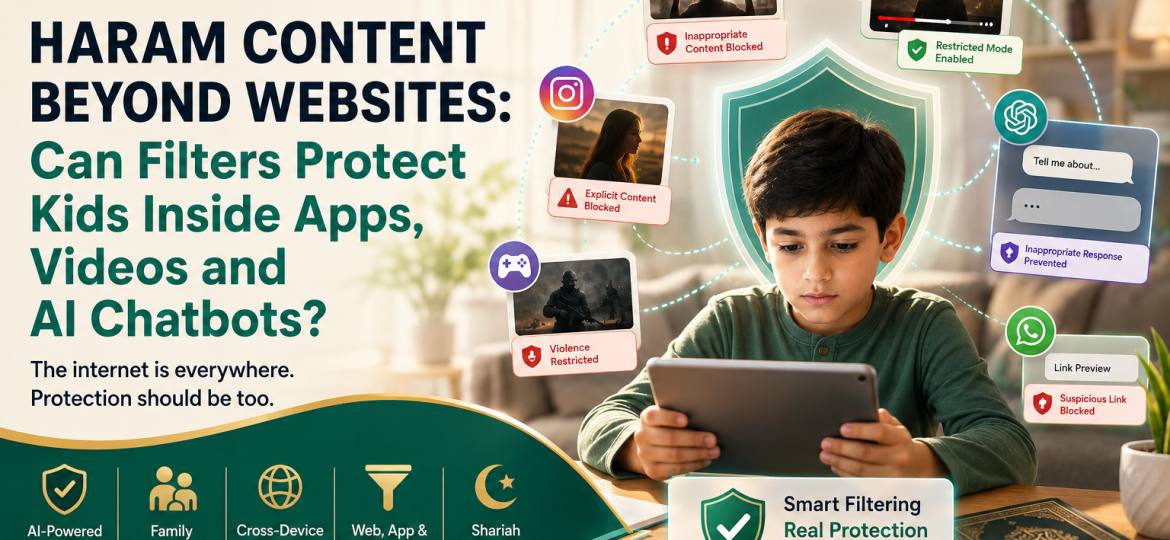
Today, inappropriate content can appear inside a TikTok feed, a YouTube recommendation, a messaging app, an embedded browser, a gaming community—or even during a conversation with an AI chatbot.
A child may never type an adult website address.
They may never deliberately search for inappropriate material.
The content can come to them.
That creates an important question for Muslim parents:
Can haram content filters still protect children when so much online activity happens beyond traditional websites?
The answer is yes, but only to a point.
A modern filtering system can create valuable layers of protection, but no single VPN, DNS filter, parental-control app, browser setting or AI system can reliably understand and control everything happening inside every third-party app.
Understanding that limitation is not a weakness.
It is the starting point for building a stronger family safety strategy.
HalalVPN’s Haram Content Blocking & Filtering approach is designed around this broader problem: helping Muslim families reduce exposure to categories such as adult material, gambling, intoxicant-related content, scams, phishing and other unwanted material while maintaining greater control over the family internet environment.
But the modern internet requires parents to think beyond a simple blocked website / allowed website model.
The Problem Has Changed: Haram Content Is No Longer Confined to Haram Websites
Imagine a child searching Google for a school project.
SafeSearch is enabled.
The browser is supervised.
Adult websites are blocked.
Everything seems fine.
Later, the child opens YouTube.
A harmless video leads to another recommendation.
Then another.
A thumbnail appears that the family considers inappropriate.
Afterwards, the child opens TikTok and receives videos selected by the platform’s recommendation system.
A friend sends a link through another app.
That link opens inside an in-app browser.
In the evening, the child asks an AI chatbot a personal question and continues the conversation for twenty minutes.
None of those experiences necessarily passed through the same filtering layer.
That is the central problem.
Today’s online safety challenge is not one internet. It is many overlapping digital environments.
Children move between:
- websites;
- social feeds;
- video platforms;
- apps;
- games;
- private messages;
- in-app browsers;
- AI assistants;
- AI companion services;
- search engines;
- recommendation systems.
Each environment has its own technology and safety controls.
What Does a Haram Content Filter Actually See?
Before judging whether filtering “works,” parents need to understand what the filter is technically capable of seeing.
There are several different levels of filtering.
Domain-Level Filtering
This is one of the simplest approaches.
A system may recognize that a child is attempting to connect to:
example-adult-site.com
and block the entire domain.
This works well when the whole website belongs to a clearly inappropriate category.
It is much more difficult when a single platform contains millions of pieces of both useful and inappropriate content.
YouTube is a good example.
Blocking the entire YouTube domain would stop inappropriate videos.
It would also stop mathematics lessons, science tutorials, Qur’an recitations, language classes and educational documentaries.
Modern family filtering therefore needs more nuance than a list of forbidden domains.
HTTPS Makes Content-Level Filtering More Complicated
Most modern web traffic is encrypted using HTTPS.
That is good for privacy.
It also affects what network-based filtering systems can inspect.
Cloudflare’s technical documentation explains that without TLS decryption, a network security service may know that a user visited a particular domain but cannot necessarily see the full URL, request information or other encrypted content. Deeper inspection requires additional techniques such as TLS inspection.
This matters because parents sometimes assume:
“If my filter can see YouTube, it can see every YouTube video.”
That does not automatically follow.
A network may be able to identify the service being used while having much less visibility into the exact content being consumed inside it.
Native apps can make this even more complicated because some applications use technologies such as certificate pinning or proprietary protocols that restrict external inspection.
So when evaluating any parental-control or halal-filtering product, avoid unrealistic expectations.
The better question is not:
“Does it block everything?”
Ask:
“Which layer does it protect, and what happens when my child moves outside that layer?”
Can Haram Filters Protect Children Inside Social Media Apps?
Partially.
But social-media protection is one of the hardest areas for traditional filtering systems.
Consider TikTok.
A network-level filter may be able to:
- allow TikTok;
- block TikTok;
- restrict access at particular times;
- potentially identify some categories of network activity depending on the technology being used.
But allowing TikTok creates another challenge.
The child is now inside TikTok’s own content environment.
The videos, recommendations, comments and accounts displayed there are primarily being selected and managed by TikTok itself.
That is why platform-level parental controls become essential.
TikTok Needs Its Own Safety Layer
TikTok currently provides Family Pairing, which lets parents or guardians link their account with a teenager’s account and manage several safety settings.
Depending on the account and region, these can include:
- Restricted Mode;
- daily screen-time controls;
- scheduled time away;
- keyword filtering;
- privacy settings;
- account interaction controls.
TikTok specifically allows parents to manage Restricted Mode through Family Pairing.
This illustrates an important principle.
A family content filter and TikTok Family Pairing should not be treated as competitors.
They work at different layers.
A broader filter may help control whether a platform can be reached.
TikTok’s own controls help manage what happens once the child is using TikTok.
For stronger protection, parents may need both.
Why Social Feeds Are Different From Websites
Traditional website filtering is often based on a request.
The child asks to visit a page.
The filter decides:
Allow or block?
A recommendation feed works differently.
The child may simply scroll.
The platform decides what appears next.
That means inappropriate content can be algorithmically delivered without a deliberate search.
This is why Muslim parents should not rely only on browser history.
A child can encounter questionable content without ever typing a questionable search term.
That distinction—searching for content versus being exposed to content—is one of the most important changes in modern digital parenting.
Can Filters Protect Children on YouTube?
Again, protection is possible, but it requires several layers.
YouTube offers supervised experiences for children, and parents can choose content settings through Family Link or YouTube’s Family Center.
YouTube also offers Restricted Mode, which is designed to help screen potentially mature content.
Those tools matter.
But parents should understand what they actually mean.
YouTube Contains Both Valuable and Unwanted Content
A domain-level filter faces an obvious problem with YouTube.
The platform might contain:
- Islamic lectures;
- Qur’an lessons;
- school tutorials;
- cartoons;
- documentaries;
- pornography-related discussions;
- sexualized entertainment;
- violent clips;
- gambling promotions;
- misleading advertisements.
A simple system cannot meaningfully classify the entire platform as halal or haram.
The real challenge is classification inside the platform.
That is why YouTube’s own account supervision and content controls become important.
Google allows parents to choose different content settings for supervised children’s YouTube accounts.
Mainstream “Safe” Does Not Always Mean “Suitable for My Muslim Family”
This distinction deserves careful attention.
A platform may consider something suitable for a particular age while a Muslim family may still decide it conflicts with their own values.
For example, parents may want stronger boundaries around:
- sexualized imagery;
- dating content;
- gambling;
- alcohol promotion;
- immodest material;
- offensive language;
- harmful social trends.
Platform safety policies are normally designed for broad populations.
They are not designed to make individual Islamic judgments for every family.
That is where a faith-aware filtering philosophy becomes useful.
The goal is not to accuse every mainstream platform of being unsafe.
The goal is to recognize that general age appropriateness and Islamic content preferences are not always identical standards.
What About In-App Browsers?
This is one of the easiest safety gaps for parents to miss.
An in-app browser is a webpage that opens inside another application instead of opening in Chrome, Safari or another standalone browser.
You tap a link in an app.
A webpage appears.
But technically, you may still be inside that app’s browsing environment.
Children encounter this constantly through:
- messaging apps;
- social networks;
- gaming apps;
- email;
- shopping applications;
- news apps.
To the child, it looks like a normal website.
To a parental-control system, it may not behave exactly like Chrome or Safari.
Why Browser Restrictions May Not Behave Identically Inside Every App
Android now includes device-level parental controls that can help block explicit websites.
Apple also provides web-content controls through Screen Time, including options to limit adult websites or permit only approved sites.
These are valuable protections.
But app architecture matters.
Not every app processes web content in exactly the same way, and not every network filter has the same visibility into every embedded browsing session.
That means parents should actually test the apps their children use rather than assuming browser restrictions automatically behave identically everywhere.
A Simple Parent Test
You do not need to teach children bypass techniques to test your protection.
Choose a harmless website that you intentionally place on your blocked list.
Then try opening it through:
- the child’s main browser;
- Google Search;
- a link inside a messaging app;
- a social-media app;
- another installed browser.
If the same restriction works everywhere, good.
If it does not, you have found a gap.
Finding a gap during a test is much better than discovering it after your child encounters something harmful.
AI Chatbots Create a Completely New Content-Filtering Problem
AI chatbots are different from websites, search engines and social feeds.
A website usually delivers content that already exists.
A generative AI chatbot can create a new response in real time.
That response may never have existed anywhere on the web before the child asked the question.
This changes how filtering has to work.
A traditional domain blocklist cannot meaningfully classify every sentence an AI system might generate.
And this is becoming a mainstream parenting issue rather than a distant future problem.
Ofcom reported in May 2026 that 56% of UK children aged 8–17 had used AI, rising to 66% among 16–17-year-olds. It also found that 11% of 8–17-year-olds said they had used AI as someone to talk to or “as a friend.”
UNICEF has separately highlighted emerging risks around AI chatbots and companions, including inappropriate content, manipulation, privacy issues and emotional dependency.
This deserves serious parental attention.
Blocking an AI Website Is Easy. Controlling Every AI Answer Is Not.
From a network perspective, a parent may choose to block an AI service entirely.
That is relatively straightforward.
The harder situation is:
“I want my child to use AI for homework, but I don’t want inappropriate conversations or harmful content.”
That requires platform-level safety.
It cannot be solved reliably by simply categorizing the domain as “AI.”
The platform itself needs:
- age-aware safety policies;
- moderation;
- account protections;
- parental controls;
- appropriate content restrictions.
Different AI Platforms Have Different Safety Systems
Parents should never assume that every chatbot has the same safeguards.
For example, ChatGPT currently provides parental controls that allow parents and teens to link accounts and manage parts of the teen experience. OpenAI also applies additional protections to accounts identified as belonging to users under 18.
ChatGPT is not intended for children under 13, and OpenAI says users aged 13–18 require parental consent.
Other chatbot services may have very different rules.
This means parents need to evaluate the specific AI product, not simply the category “AI chatbot.”
Can a Halal Filter Decide Whether an AI Conversation Is Halal?
Not reliably in every circumstance.
This is where technology companies need to be careful with promises.
Suppose a child asks an AI:
“Why is gambling haram?”
The chatbot may use words such as:
- casino;
- betting;
- gambling;
- lottery.
A simple keyword filter could misunderstand the conversation and block educational Islamic content.
Now imagine another conversation where someone subtly encourages gambling without using obvious keywords.
A simple blocklist might miss it.
That is why context matters.
Modern AI-assisted filtering can potentially make better judgments than basic keyword matching, but no automated system should be marketed as possessing perfect religious understanding.
A credible halal filtering system should aim to support Muslim values, not pretend to replace Islamic scholarship, parental judgment or human responsibility.
Context Is the Next Big Challenge for Haram Content Filtering
Consider three pages:
Page A
An online casino promoting betting.
Page B
A news report discussing gambling addiction.
Page C
An Islamic article explaining why gambling is prohibited.
All three may contain the word “gambling.”
But they do not serve the same purpose.
A strong filtering system should ideally distinguish between:
promotion, neutral discussion and educational criticism.
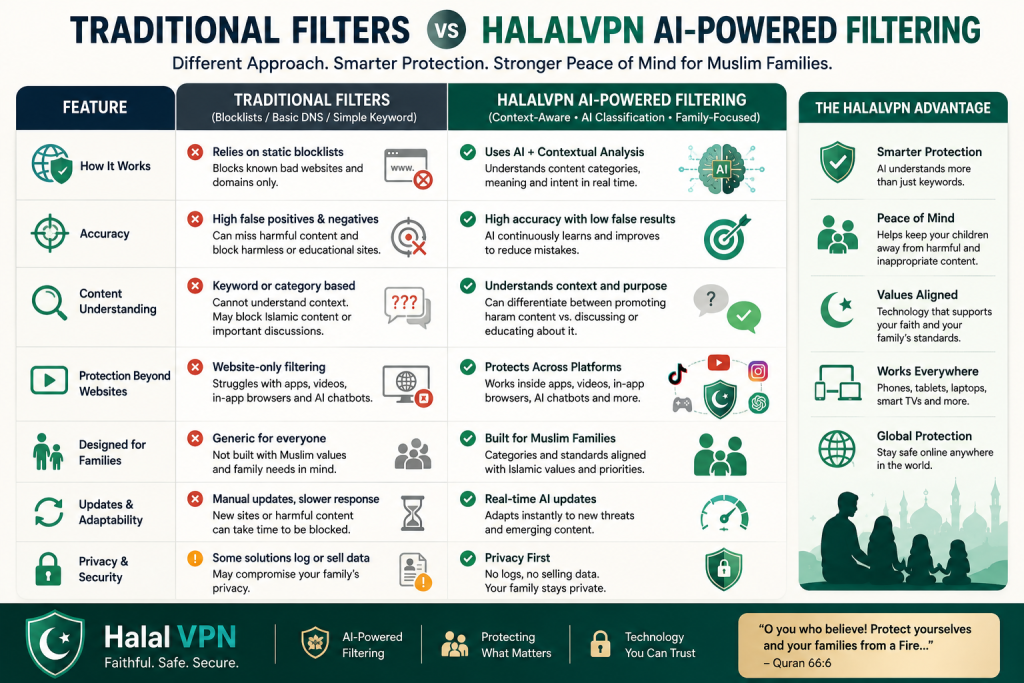
This is one reason HalalVPN’s broader Haram Content Blocking & Filtering concept is more useful when understood as intelligent category and content assessment rather than simply maintaining a list of forbidden words. HalalVPN says its HalalFilter is designed to assess content and site categories to restrict areas including adult material, gambling, intoxicants, scams, phishing and malware.
That approach is much closer to the problem modern families actually face.
Videos Are Especially Difficult to Filter
Video combines several signals:
- visuals;
- audio;
- subtitles;
- titles;
- descriptions;
- comments;
- thumbnails;
- live chat.
A filtering system that examines only the URL may know:
“This is YouTube.”
It may not know exactly what happens 14 minutes into a particular video.
An AI-based visual system may identify certain types of imagery.
Speech analysis may evaluate audio.
Text systems may analyse captions or metadata.
But combining all of these accurately and instantly is difficult.
False positives and false negatives remain possible.
That is why families should avoid believing claims such as:
“Our AI catches 100% of inappropriate video content.”
No responsible safety strategy should depend on that promise.
What About Images Generated by AI?
Generative AI introduces another category entirely.
Children can now ask some systems to create images rather than simply searching for existing ones.
That means parental safety increasingly needs to consider:
- AI image generation;
- image editing;
- synthetic characters;
- sexually suggestive prompts;
- deepfakes;
- manipulated images.
UNICEF has specifically identified AI-generated explicit deepfakes and AI-generated child sexual abuse material among emerging harms affecting children.
This is another reason why network-level content blocking alone cannot solve every problem.
Some protection must happen inside the AI platform itself.
The Right Model: Layered Protection
Instead of searching for one perfect app, think in layers.
Layer 1: Network Protection
This layer can help control which domains, services or categories devices can reach.
It is useful for broad filtering, malicious websites, adult domains, gambling sites and other identifiable online categories.
A solution such as HalalVPN’s Haram Content Blocking & Filtering for Muslim Families belongs within this broader protection layer.
Layer 2: Device Controls
Use the parental controls built into the child’s device.
Apple’s Screen Time can manage app installation, explicit content, website restrictions, privacy settings and other limits.
Android also provides parental controls for web content and other device-level restrictions.
Layer 3: Platform Controls
Configure the apps individually.
For example:
TikTok: Family Pairing and Restricted Mode.
YouTube: supervised accounts, content settings and Restricted Mode.
AI tools: use the provider’s teen settings and parental controls where available.
A network filter cannot replace these controls.
Layer 4: App Installation Control
For younger children, parents should consider whether children need permission before installing new apps.
This prevents a common problem:
A carefully configured device gains a new browser, social app, VPN or chatbot that the parent has never reviewed.
Apple allows parents to restrict application installation and purchases through Screen Time.
Layer 5: Family Rules
Technology works much better when children understand the rules behind it.
A family might decide:
- no private AI companion apps;
- YouTube only through the supervised account;
- new apps require permission;
- no devices after bedtime;
- uncomfortable content should be reported to a parent;
- online strangers should never receive personal information.
These rules do not require expensive technology.
They require consistency.
Muslim Parents Should Ask More Than “Is This App Safe?”
A better set of questions is:
What can my child see?
Does the service contain mature, sexualized, gambling-related or otherwise inappropriate content?
How does content reach them?
Do they search for it, or does an algorithm recommend it?
Can strangers contact them?
Content safety and interaction safety are different issues.
Does the app contain its own browser?
Could outside content open without the normal browser?
Does the platform use AI?
Could a chatbot generate responses rather than simply displaying existing content?
What controls exist?
Are there parent accounts, supervised profiles, Restricted Mode or age settings?
Can my wider family filter see activity inside the service?
Sometimes yes.
Sometimes partially.
Sometimes only the domain is visible.
That distinction matters.
Don’t Confuse Filtering With Surveillance
More technical visibility is not automatically better parenting.
Deep inspection can create its own privacy questions.
For example, enterprise security systems that inspect encrypted HTTPS traffic may need to decrypt and re-encrypt the connection using trusted certificates. Cloudflare and Palo Alto both document this approach for security inspection.
A family product should therefore be transparent about:
- what it examines;
- what it stores;
- what parents can see;
- how children’s data is handled;
- how long information is retained.
Protecting children from harmful content should not require unnecessarily exposing all of their private information.
Privacy and safety should be designed together.
Avoid the “100% Protected” Mindset
No responsible parent should be told:
Install this app and your child can never encounter inappropriate content again.
The internet is too complex for that promise.
Apps change.
AI models change.
New platforms appear.
Recommendation algorithms evolve.
Children move between home Wi-Fi, mobile networks, school devices and friends’ devices.
Even the largest platforms use multiple layers rather than claiming a perfect filter.
YouTube maintains supervised experiences and Restricted Mode.
TikTok provides Family Pairing and Restricted Mode.
AI providers are increasingly developing age-aware safeguards and parental controls.
The lesson is clear:
Strong protection comes from overlapping safeguards, not one magic switch.
A Practical 15-Minute Safety Check for Parents
Once a month, review your child’s digital environment.
1. Check installed apps
Look for new:
- social platforms;
- browsers;
- VPNs;
- AI apps;
- gaming or messaging services.
Do not automatically assume an unfamiliar app is dangerous.
Research it first.
2. Check YouTube supervision
Confirm that the correct account and content settings are still active.
3. Review TikTok Family Pairing
Check Restricted Mode, screen-time settings and privacy controls.
4. Review AI tools
Ask which AI systems your child is using.
Check the service’s minimum age and available parental controls.
5. Test in-app links
Make sure your broader web restrictions behave as expected when links open inside apps.
6. Review the family filter
Check whether filtering categories still match the child’s age and your family preferences.
7. Ask one simple question
“Has anything online made you uncomfortable recently?”
That question can uncover something no technical dashboard can.
How Halal Content Filtering Should Evolve
The next generation of Muslim-focused family protection should move beyond the idea of simply maintaining a blacklist of adult websites.
Families increasingly need systems that can help with:
- category-based blocking;
- contextual classification;
- inappropriate-content detection;
- phishing and malware protection;
- gambling restrictions;
- adult-content blocking;
- trusted allowlists;
- family profiles;
- cross-device protection;
- transparent privacy controls.
Most importantly, these systems need to acknowledge their limits.
A faith-aware filter should not claim to understand every Islamic ruling.
It should provide practical technology that helps families enforce the boundaries they have chosen.
That is a far more useful role.
To explore how HalalVPN approaches this wider problem, visit the cluster guide: Haram Content Blocking & Filtering for Muslim Families.
Frequently Asked Questions
Can parental controls filter content inside apps?
Sometimes. Device-level and platform-level controls can restrict certain content or app features, but coverage varies according to the device, operating system, app and filtering technology. Parents should configure both device controls and individual platform controls.
Can a VPN block inappropriate videos inside YouTube?
A VPN or network filter may be able to block YouTube entirely or restrict certain network traffic, but identifying every inappropriate individual video is a much harder problem. YouTube’s own supervised-account settings and Restricted Mode provide an additional platform-level protection layer.
Can filters block TikTok content?
Parents can restrict access to TikTok at the network or device level. If TikTok is allowed, the platform’s own Family Pairing and Restricted Mode settings provide additional controls over the teen experience.
Can a content filter see websites opened inside another app?
It depends on the operating system, app and filtering method. Some device-level web restrictions may extend into supported web views, while other app environments may behave differently. Parents should test the actual apps installed on the child’s device.
Can parental controls protect children using AI chatbots?
Some AI platforms now provide teen protections and parental controls, but the features vary greatly by provider. For example, ChatGPT offers linked parental controls and additional safeguards for teen accounts.
Are AI chatbots safe for children?
AI can be useful for education and creativity, but it also presents emerging risks. UNICEF has highlighted concerns involving inappropriate content, privacy, manipulation and emotional dependency, particularly with AI companion systems.
Is a halal content filter enough on its own?
No. A stronger strategy combines network filtering, device controls, app-specific settings, age-appropriate supervision, privacy protections and regular communication with children.
Final Thoughts: Protect the Digital Environment, Not Just the Browser
Parents used to worry primarily about which websites their children visited.
Now they also have to think about:
Which videos are being recommended?
What appears inside an app?
What happens when a link opens in an embedded browser?
What is an AI chatbot generating during a private conversation?
This makes parental protection more complicated.
But it does not make protection impossible.
The solution is to stop looking for one perfect filter.
Use layers.
A halal content filter can help protect the wider connection.
Device controls can restrict apps and websites.
TikTok and YouTube controls can manage platform-specific risks.
AI parental settings can address chatbot use where providers offer them.
And conversations with children can cover the places technology cannot see.
For Muslim families, this creates a more realistic goal:
not a perfectly sealed internet, but a safer digital environment built around privacy, responsibility and Islamic values.
Technology can help establish the boundaries.
Parents still provide the guidance that gives those boundaries meaning.