The internet connects billions of people, but not all of it is safe or suitable for Muslim families. Explicit content, misleading information, and cultural influences that oppose Islamic values have become almost unavoidable. For many, it feels impossible to browse without being exposed to something inappropriate.
That’s where technology itself can become part of the solution. Just as harmful systems can spread indecency, new digital tools can be designed to protect modesty and faith. Artificial Intelligence (AI), when used responsibly, is helping create a cleaner, halal online environment one that filters haram material and supports Muslims in using the internet without compromise.

Understanding the Role of AI in the Online World
Every major platform today uses AI from YouTube recommendations to spam filters in email. In essence, AI is a system that learns from data. It observes patterns, predicts behavior, and automates responses.
When misused, AI can trap people in unhealthy online loops pushing content that grabs attention, not what benefits the soul. But when applied with purpose and ethical guidance, it can do the opposite: remove harmful content, identify risk, and create safer digital experiences.
For the Muslim community, this is more than a technical matter — it’s about protecting iman (faith) in a world of constant exposure.
Why Muslims Need Smarter Protection Online
Islam emphasizes both personal responsibility and community safeguards. Just as we rely on halal certification for food, Muslims now need similar protection for their digital intake.
The online world poses unique spiritual risks:
- Instant exposure to haram visuals or language.
- Algorithms that normalize indecency or disbelief.
- Data misuse and privacy invasion.
- Children encountering harmful material before maturity.
AI-based filtering provides a new kind of hisbah — a system that enjoins good and blocks evil — automatically, without the need for constant manual supervision. It ensures that technology works for the believer, not against them.
How AI Shapes a Halal Internet
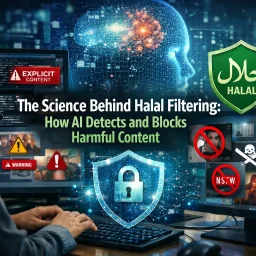
AI can analyze text, images, and videos in real time to identify what is safe and what is not. When this process is guided by Islamic principles, it creates what we can call a “Halal Internet” a digital environment clean of haram content and respectful of moral boundaries.
Here’s how it works in practice:
1. Content Recognition and Filtering
AI scans websites, search results, and media to detect explicit, violent, or inappropriate material. It recognizes patterns that human filters might miss, such as blurred or disguised visuals, and blocks them before they appear on screen.
2. Contextual Understanding
Unlike traditional filters that rely only on keywords, AI can understand context. For example, it can distinguish between an educational article about health and a page promoting indecent content. This ensures legitimate information isn’t accidentally censored.
3. Continuous Learning
AI improves with time. It learns from user feedback and updates its filters based on new threats or trends, adapting to changes in online content. This makes it more reliable than static parental controls or outdated blocklists.
4. Faith-Based Parameters
When developers design AI systems specifically for Muslims, they can include guidelines based on Islamic teachings for example, avoiding material that promotes nudity, alcohol, gambling, or blasphemy.
This is exactly what tools like Halal VPN are introducing: advanced technology built around values, not just efficiency.
Comparison: Traditional Filters vs. AI-Based Halal Protection
| Feature | Traditional Internet Filters | AI-Based Halal Protection (HalalVPN) |
| Detection Method | Blocks by keywords or domains only | Analyzes full text, images, and video context |
| Accuracy | High chance of false blocks or missed threats | Learns continuously for better precision |
| Faith Alignment | Generic “family-safe” filtering | Guided by Islamic principles and halal standards |
| Scope | Limited to specific websites | Works across browsers, apps, and devices |
| User Experience | Often frustrating or restrictive | Smooth, private, and adaptive browsing |
This is the difference between restrictive protection and purposeful protection. One simply blocks access; the other preserves dignity and faith while maintaining a positive online experience.
Ethical Technology: A Modern Amanah
Islam teaches that every innovation must serve humanity and align with moral responsibility. AI, like any tool, is neutral, it becomes good or bad depending on how it’s used.
The Prophet ﷺ said, “Every one of you is a shepherd, and every one of you is responsible for his flock.” (Bukhari & Muslim)
This applies today to the digital flock our families, communities, and personal devices.
Developers building faith-based technology carry a new kind of amanah (trust). They must ensure that their systems protect the user’s modesty, privacy, and dignity. Muslims using such tools fulfill their own responsibility to guard what enters their hearts and homes.
The Halal VPN Approach to Faith-Aware AI
Halal VPN takes this principle seriously. Its filtering system uses AI not just for security but for spiritual safety.
Here’s what makes it different:
- Haram content detection: The system identifies and blocks explicit material, indecent visuals, and websites promoting un-Islamic behavior.
- Privacy protection: Browsing activity remains private and encrypted, reflecting Islamic values of modesty and discretion.
- Family dashboard: Parents can manage devices, set healthy limits, and monitor activity without invading personal privacy.
- Community-based learning: The AI model improves through real-world use within the Muslim community, ensuring relevance and reliability.
Halal VPN represents a growing movement: Muslim-led technology solving Muslim problems with sincerity and precision.
How AI Can Empower the Muslim Ummah
Faith-friendly AI doesn’t only protect users; it can also strengthen the global Muslim digital presence. Here’s how:
1. Authentic Islamic Knowledge
AI can help curate reliable Islamic content, distinguishing authentic scholars from misinformation. It can surface verified fatwas, Qur’an translations, and educational videos.
2. Online Dawah
Muslims producing clean, high-quality content benefit from algorithms that recognize and promote beneficial material. AI can help amplify positive voices and reduce exposure to harmful trends.
3. Family and Youth Empowerment
Children and teenagers can browse safely, learning within moral limits. This builds confidence in their identity and reduces the conflict between technology and religion.
4. Global Representation
When Muslims build and adopt halal technologies, it shows the world that Islam leads innovation ethically. It challenges the idea that modernity requires moral compromise.
Using AI with Wisdom
While AI helps create a safer internet, personal discipline still matters. No system replaces human intention. Muslims should continue practicing taqwa (God-consciousness) in how they use devices, what they search for, and how they engage online.
Here are balanced steps to combine faith and technology:
- Begin with dua. Ask Allah to purify your intentions in using technology.
- Use protective tools. Install halal filters and VPNs for family safety.
- Be mindful of time. Limit entertainment and social media.
- Support ethical platforms. Use and promote services that align with Islamic values.
- Teach others. Share what you learn about digital responsibility within your circles.
AI is a tool it amplifies human behavior. Guided by taqwa, it becomes a means of preserving faith; used carelessly, it can do the opposite.
A Vision for the Future
Imagine an internet where Muslims don’t need to worry about what might appear on their screens — where parents can give devices to children with peace of mind, and where faith and technology coexist naturally.
That vision is not far away. As more Muslim developers, entrepreneurs, and families embrace faith-driven innovation, the concept of a halal digital environment will expand.
HalalVPN’s use of AI is an early sign of that shift — from being passive users of global technology to being active shapers of ethical innovation.
Conclusion
The digital world is here to stay, but its direction is still being written. Artificial Intelligence can either push humanity deeper into indecency or lift it toward responsibility. The choice lies in who designs it and for what purpose.
For Muslims, the goal is not just to survive the internet, it’s to purify it. AI-driven halal technology, like Halal VPN, makes that goal possible. It transforms technology from a source of temptation into a tool of protection.
A safer, halal internet is not a dream. It’s a necessary evolution one where faith defines the framework, and technology follows.
As the Prophet ﷺ taught, “The believer is not stung from the same hole twice.” We’ve seen what an unfiltered internet can do. Now, it’s time to build something better an online world guided by values, powered by purpose, and protected by faith.