The internet was built to share information freely but that freedom comes with risks. For Muslims who value modesty, morality, and family safety, online access without boundaries often leads to unintentional exposure to haram (forbidden) material.
From social media videos and pop-up ads to entertainment sites and mobile games, explicit and inappropriate content is only a click away. No one sets out to find it yet it reaches us, our children, and our homes.
This is where Halal filtering comes in a modern technological approach to an age-old Islamic value: protecting the heart, the eyes, and the soul from corruption.
What Is Halal Filtering?
Halal filtering refers to the process of screening, detecting, and blocking online content that violates Islamic ethical and moral guidelines. It ensures that the material displayed to a user is in line with the principles of modesty, decency, and truth.
Unlike generic “family-safe” filters, halal filtering follows faith-based standards. It doesn’t only block nudity or violence it also filters out content promoting alcohol, gambling, profanity, blasphemy, and un-Islamic ideologies. The goal isn’t to limit freedom it’s to guide usage toward what benefits rather than harms.
The Role of AI in Modern Halal Filtering
In the early days of the internet, content filtering was basic — mostly keyword-based. If a webpage contained a forbidden word, it was blocked. But this method often failed. It couldn’t tell the difference between a medical article discussing anatomy and a site showing explicit imagery.
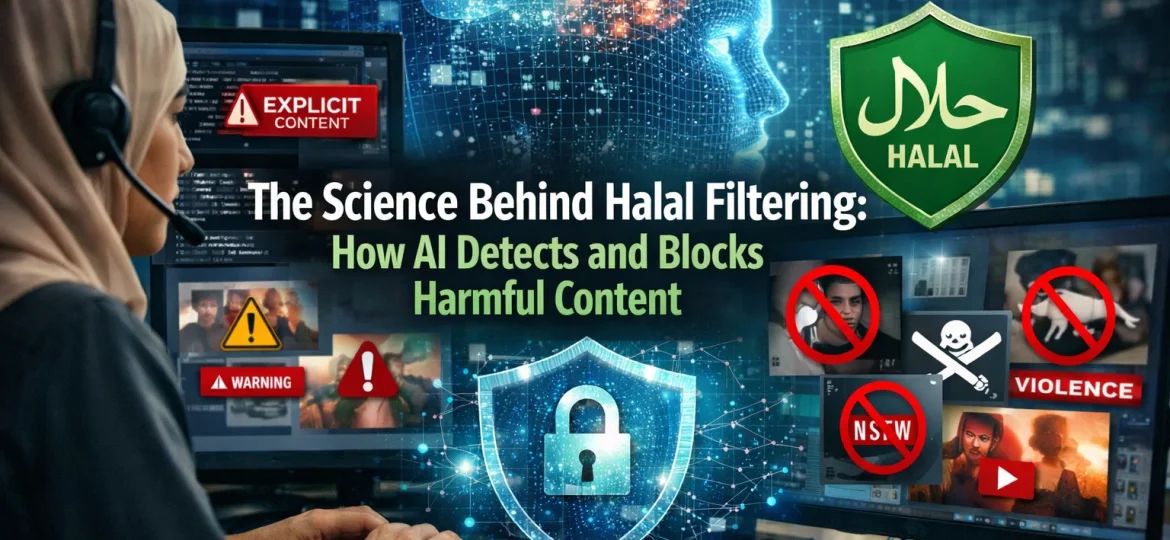
Modern halal filtering uses Artificial Intelligence (AI) to overcome these limitations. AI adds context, precision, and adaptability making it possible to identify haram content accurately and in real time.
How It Works
AI-powered halal filtering follows a multi-layered process that includes:
- Content Classification
AI scans and categorizes every website, image, video, or app according to its nature. It identifies whether the content belongs to education, entertainment, religion, news, or adult categories. - Image and Video Recognition
AI models can detect visual content, including skin exposure, gestures, and context within images or frames. It doesn’t rely only on text; it analyzes visuals the way the human eye would. - Language Processing
Many inappropriate materials hide behind harmless-sounding words or coded language. Natural Language Processing (NLP) allows AI to understand meaning — distinguishing between a religious discussion about alcohol prohibition and a website promoting its sale. - Behavioral Analysis
AI observes user interactions. If someone repeatedly visits risky or inappropriate websites, the system strengthens protection by adjusting filtering intensity. - Feedback Loop
When users mark something as “unsafe,” the system learns from the correction. Over time, the filter becomes more accurate and culturally aware of Muslim sensitivities.
This continuous cycle of detection, feedback, and improvement is what makes AI-based halal filtering smarter and more reliable than traditional filters.
Understanding the Science Behind Detection
1. Visual Recognition Models
AI uses computer vision to detect inappropriate visuals. These systems are trained on millions of images — both safe and unsafe to recognize patterns associated with nudity, violence, or indecent exposure.
When a webpage loads, the system scans the image before it reaches the user’s screen. If it detects a visual breach of modesty (for example, revealing clothing, explicit gestures, or indecent symbols), the image is blurred or blocked instantly.
2. Textual and Contextual Understanding
AI doesn’t stop at words. It studies the context behind them. For instance, the word “wine” could appear in a history article or in an advertisement. Halal filtering uses contextual AI to determine whether the mention is informational or promotional.
This allows Muslim users to access knowledge while staying safe from content that normalizes haram acts.
3. Audio and Speech Detection
Video and podcast content can also be scanned for profanity or blasphemous speech. AI models detect sound patterns and language to mute or skip offensive segments automatically.
4. Ad and Tracker Blocking
Many websites are filled with third-party ads that lead to inappropriate pages. AI-based halal filters analyze ad networks and block entire ad sources known for risky or adult material. This not only protects faith but also enhances online privacy.
The Islamic Framework Behind Halal Filtering
Halal filtering isn’t just a technical system it’s a digital expression of Islamic ethics. It reflects the same principles that guide Muslims in food, finance, and lifestyle choices.
The Qur’an instructs believers to lower their gaze and avoid indecency. In a digital world, lowering the gaze means building systems that prevent indecent content from appearing in the first place.
From a fiqh (jurisprudence) perspective, technology that helps prevent exposure to sin serves the objectives of Shariah namely, the protection of faith (deen), intellect (‘aql), and family (nasl).
In other words, halal filtering is not optional it’s an application of Islamic responsibility in a modern context.
Comparison: Generic Filters vs. Halal Filtering
| Feature | Generic “Family-Safe” Filter | Halal Filtering (HalalVPN Approach) |
| Filtering Basis | Blocks adult or violent content using global safety lists | Filters according to Islamic ethical rules and moral standards |
| Scope | Primarily English content | Multilingual and culturally aware (Arabic, Urdu, Malay, etc.) |
| Content Understanding | Keyword or category based | AI-powered context and visual recognition |
| Faith Sensitivity | Neutral toward religion or modesty | Blocks content conflicting with Islamic beliefs or modesty |
| Privacy Protection | Often collects user data | Prioritizes digital privacy and discretion as part of Islamic modesty |
The Halal VPN Filtering System
Halal VPN integrates this AI-powered halal filtering technology into a secure and private virtual network. It doesn’t just hide your IP address — it purifies your internet access.
Key Components:
- Faith-Aware AI Filtering
Detects and blocks explicit or haram material before it reaches the device. - Central Family Dashboard
Allows parents to manage devices, view reports, and control access levels across all family members. - Multi-Device Protection
Covers phones, tablets, laptops, and smart TVs under one halal environment. - Data Privacy and Encryption
Prevents tracking, surveillance, and exploitation of user information — aligning with Islamic principles of modesty and privacy. - Continuous Learning
The AI engine is trained on real-world feedback from the Muslim user base, ensuring culturally accurate performance.
This makes HalalVPN a practical tool for families, schools, and Islamic organizations seeking faith-aligned digital protection.
Why This Technology Matters
1. For Families
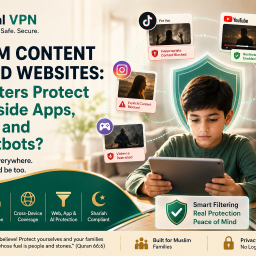
Parents no longer have to rely solely on supervision. Halal filtering automates the process of protection, reducing anxiety about what children might see online.
2. For Professionals and Students
It helps adults focus on productivity without unnecessary distractions, keeping online behavior consistent with Islamic ethics even in work or study settings.
3. For the Ummah at Large
As more Muslims use faith-based technology, it sets a new global standard one where the digital environment supports, rather than undermines, Islamic living.
Limitations and Responsibility
No filter is perfect. The internet evolves faster than any system can fully control. Some inappropriate material may still slip through, while certain educational resources may be mistakenly blocked.
That’s why human intention remains central. Halal filtering is a tool not a replacement for self-discipline or parental guidance.
Muslims are still expected to practice taqwa (God-consciousness), choosing what to view and avoiding what displeases Allah. The Prophet ﷺ said, “When you have no shame, do whatever you wish.” (Bukhari)
A pure digital environment begins with the user’s own commitment to purity.
The Future of Halal Internet Safety
Halal filtering is only the beginning. The next phase of Islamic technology includes:
- Halal-certified content platforms where all material meets Islamic standards.
- Faith-based social networks designed around community benefit, not vanity metrics.
- Islamic AI models trained specifically for Arabic and cultural nuances in modesty detection.
The long-term vision is a digital ecosystem where Muslims don’t need to choose between connection and conscience where technology is not a threat to faith but a guardian of it.
Conclusion
The science behind halal filtering is both technical and spiritual. It combines data analysis, image recognition, and language processing with the timeless Islamic principles of modesty and morality.
For Muslims navigating today’s online world, this technology offers hope a way to engage with the digital age safely, productively, and without compromising faith.
Halal VPN embodies this vision. By blending advanced AI protection with Islamic values, it creates an internet experience that is private, family-friendly, and truly halal.
A cleaner, safer, and more respectful digital space isn’t just possible it’s already here. And for the Muslim ummah, it marks a step forward in using innovation to preserve what matters most: our faith, our dignity, and our peace of mind.