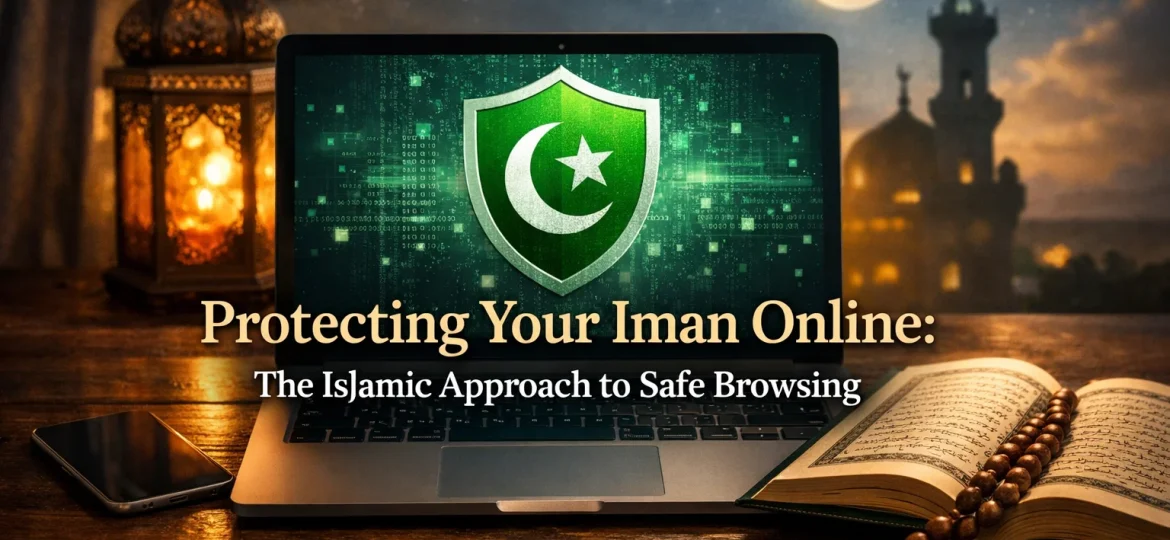
Every generation of Muslims faces its own test. In the past, it was what we saw in the marketplace or heard in the streets. Today, it’s what we see on our screens. The internet has become a part of daily life, we use it for work, education, news, and connection. Yet it also exposes us to influences that can quietly weaken Iman (faith) if left unchecked. In a world where harmful and inappropriate content can appear without warning, protecting one’s faith online has become an urgent responsibility.

The Digital Test of Our Times
Islam teaches us to guard our eyes, ears, and hearts. The Qur’an says:
“Tell the believing men to lower their gaze and guard their modesty…” (Surah An-Nur 24:30)
But how can a believer lower their gaze when inappropriate material is only one click away — or even appears without being sought?
Most Muslims don’t go online to find haram content. Yet algorithms, ads, and entertainment platforms often push content designed to attract attention, not promote modesty. It’s easy to stumble upon something that corrupts the heart even when the intention was pure.
This constant exposure makes it harder to maintain the same spiritual focus that Islam encourages. Just as we protect our diet from haram ingredients, we must protect our digital habits from haram exposure.
The Meaning of “Safe Browsing” in Islam
Safe browsing in Islam goes beyond avoiding viruses or hackers. It means using the internet in a way that safeguards faith, modesty, and truthfulness.
A Muslim’s online life should reflect the same discipline found in prayer, fasting, or business ethics. The screen doesn’t remove accountability; it increases the need for self-control.
Safe browsing from an Islamic perspective includes:
- Avoiding websites, videos, or conversations that include indecent or explicit material.
- Staying away from gossip, backbiting, or mocking others online.
- Being mindful of time spent online and avoiding excessive entertainment.
- Protecting privacy — both personal and that of others.
- Consuming information that benefits rather than distracts.
This approach turns the internet into a tool for knowledge, growth, and da’wah not temptation or confusion.
How Unfiltered Access Affects the Heart
Iman doesn’t disappear overnight; it fades slowly when the senses are exposed to what Allah forbids.
Repeatedly viewing inappropriate or harmful content desensitizes the heart. What once caused discomfort becomes normal.
Psychologically, this leads to:
- Loss of focus in worship.
- Weakened sense of guilt over haram actions.
- Increased comparison, jealousy, or materialism.
- Dependency on entertainment to escape reality.
Spiritually, it results in ghaflah heedlessness. The person no longer feels the same connection during salah or recitation. Their heart becomes distracted, not by disbelief, but by constant exposure to digital noise.
A Practical Framework for Halal Digital Habits
Creating a halal digital environment is possible — it simply requires structure and tools that make faith-friendly habits the default.
1. Begin with intention
Make the conscious intention that your online use will be halal and purposeful. Every click can be rewarded if done for good learning, earning halal income, teaching others, or helping family.
2. Identify triggers
Notice what kind of apps, content, or time of day leads to haram exposure or wasted time. Replace those triggers with Islamic reminders, Qur’an playlists, or educational videos.
3. Limit distractions
Avoid endless scrolling. Social media platforms are designed to hold your attention, not protect your soul. Set time limits or specific goals before opening any app.
4. Use protection tools
Even the most disciplined Muslim benefits from digital safeguards. Just as we lock our doors for security, we should lock our digital paths for purity.
This is where solutions like HalalVPN become essential — creating a protective layer that automatically filters harmful content and ensures privacy for the whole family.
Comparison: Regular Internet vs. Halal-Protected Browsing
The table below highlights how digital experiences change when a Muslim family uses halal protection tools like HalalVPN.
| Aspect | Regular Internet Browsing | Halal-Protected Browsing (with HalalVPN) |
| Content Exposure | Random ads, videos, and websites may contain haram or inappropriate visuals | Filters out explicit or haram content automatically before it loads |
| Privacy & Data | Browsing data often tracked by companies and advertisers | Encrypted connection hides activity and location from trackers |
| Family Safety | Parents must monitor manually; limited control | Central dashboard with parental settings and multi-device coverage |
| Spiritual Impact | Risk of desensitization, wasted time, and distraction from deen | Cleaner environment supports focus, modesty, and iman |
| Mental Wellbeing | Overstimulation from constant exposure to negativity or comparison | Healthier browsing experience with fewer distractions |
| Cultural Fit | Generic tools built for general audiences | Built specifically for Muslim families and Islamic boundaries |
This shift is not about restricting freedom — it’s about directing it. A protected online environment gives freedom from corruption, not freedom to indulge in it.
Why the Muslim Community Needs Faith-Based Digital Tools
Most cybersecurity tools are built for general users. They block viruses, but not values.
For Muslims, the real danger isn’t just data theft — it’s the slow erosion of modesty, decency, and time.
Faith-based digital tools address this gap. They respect Islamic principles while still offering modern protection.
HalalVPN is one example of how technology can serve faith rather than challenge it.
- Filtering aligned with Islamic standards — not just “family-friendly” but genuinely halal.
- Privacy that protects dignity — because digital modesty is part of overall haya (shame and honor).
- Parental empowerment — helping Muslim parents safeguard their children’s exposure without isolating them from learning.
Encouraging Halal Habits at Home
Technology alone can’t replace family discussions. A household that values digital purity must talk openly about what is halal and haram online.
Here are practical steps for families:
- Set household guidelines. Define what’s acceptable online. Encourage curiosity but within boundaries.
- Encourage positive use. Guide children toward Islamic apps, online lectures, and community content.
- Share responsibility. Don’t make it only the parents’ job. Older siblings can set examples for younger ones.
- Reflect together. Ask: “Was what we watched today beneficial?” This small habit builds self-awareness.
When these steps are combined with filtering tools, the result is a family that uses the internet as a means of learning, not losing focus.
Protecting Faith Online Is a Collective Duty
The digital environment affects the ummah as a whole. The more Muslims consume, share, and promote halal content, the stronger the ecosystem becomes.
When Muslim developers create apps with integrity, when parents filter what enters their homes, and when youth choose modesty over exposure, the entire community benefits.
Technology doesn’t have to weaken iman. It can strengthen it — if guided by taqwa (God-consciousness).
The Halal VPN Perspective
HalalVPN is built on one simple belief: Muslims should be able to browse freely without compromising faith.
By combining privacy protection with halal filtering, it offers an online experience that matches Islamic values. Families using Halal VPN report less worry, fewer distractions, and more peace of mind knowing their screens reflect what their deen allows.
It’s not just about blocking the bad it’s about making space for the good. It turns the internet back into a place for knowledge, business, and connection, not temptation.
Conclusion
The online world is not going away but we can decide how we engage with it. Protecting Iman today means protecting what enters the eyes, ears, and heart through screens.
Safe browsing in Islam is not just a technical matter. It’s an act of worship a choice to preserve purity and honor in a space where few do. For Muslim families who want to stay connected without compromising values, building a halal digital environment is no longer optional. It’s essential.
Faith must guide every click, every scroll, and every connection. Tools like Halal VPN make that possible — turning the modern web into a space where iman stays safe and hearts stay clean.