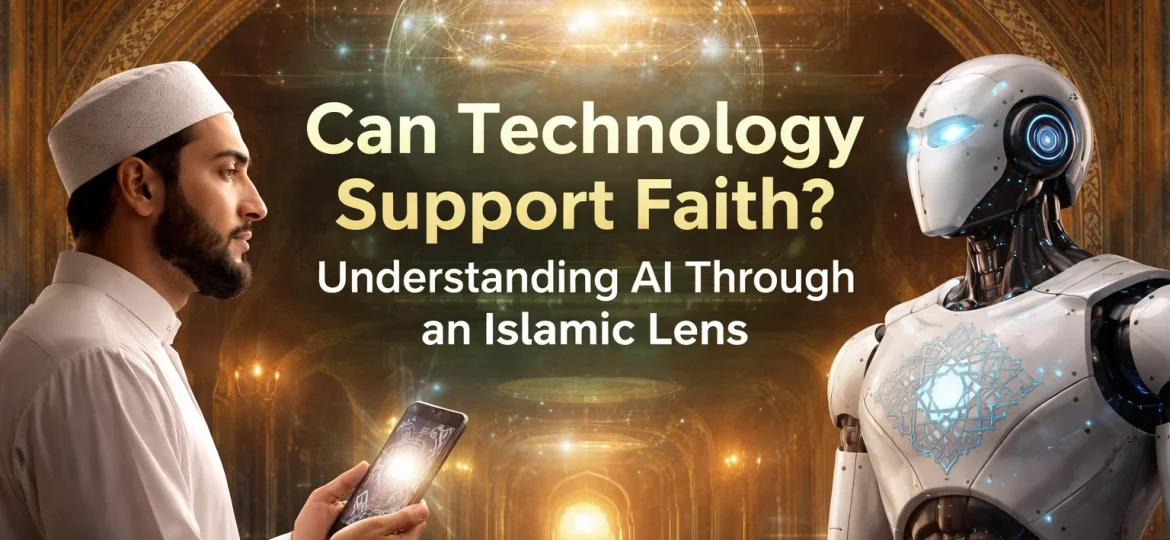
We live in a time when machines can translate languages, diagnose diseases, and even mimic human conversation. Artificial Intelligence (AI) is transforming every field from medicine to education, finance to entertainment. For Muslims, this rapid change raises an important question:
Can technology, especially AI, strengthen faith rather than weaken it?
The answer depends not on the tool itself, but on how it is built and used. Islam has always encouraged knowledge, innovation, and reflection provided they serve what is halal and benefit humanity. The challenge is ensuring that new technologies reflect moral purpose rather than material obsession.

Islam’s View on Knowledge and Innovation
Islam is not opposed to progress. The Qur’an repeatedly calls believers to observe, study, and understand the signs of Allah in creation. From the early Muslim astronomers and mathematicians to physicians and engineers, Islamic civilization once led the world in innovation grounded in faith.
The Prophet ﷺ said: “The most beloved of people to Allah are those who are most beneficial to others.” (al-Muʿjam al-Awsaṭ)
This hadith sets a timeless principle for technology: knowledge must serve goodness. Tools that benefit creation are praiseworthy; tools that spread harm, deceit, or immorality are not.
AI, when guided by ethics and responsibility, fits within that tradition. It can help protect lives, reduce hardship, and even safeguard spiritual well-being.
Understanding AI: A Modern Extension of Human Reason
At its core, AI is not a new creature or independent mind it is human reasoning reproduced in code. It gathers information, detects patterns, and makes predictions. It learns from examples the way humans learn from experience.
In Islamic thought, intellect (ʿaql) is a gift that distinguishes humankind. Using it to create helpful tools aligns with the Qur’anic command to explore the world with wisdom. But this power must always remain within moral boundaries. When humans design systems without ethics, they risk turning intellect into arrogance.
The Qur’an warns, “Do not walk upon the earth arrogantly; indeed, Allah does not like the arrogant boaster.” (31:18)
Technology becomes dangerous when it replaces humility with pride or curiosity with control.
The Faith Question: Can AI Strengthen Iman?
Yes if it is guided by Islamic intention. Here’s how:
1. By Serving Human Needs, Not Desires
AI can free people from repetitive labor, improve access to education, and enhance medical care. When designed to reduce suffering or save lives, it fulfills the Islamic goal of serving humanity.
2. By Protecting Morality Online
AI can identify and block harmful or haram content, helping Muslims and families avoid temptation. This is the principle behind halal filtering and privacy tools such as HalalVPN, which use AI to detect indecency before it appears.
3. By Preserving Islamic Knowledge
AI can digitize centuries of Islamic scholarship, making tafsir, hadith, and fiqh accessible to Muslims worldwide. It can assist translators, students, and imams in sharing authentic knowledge faster than ever before.
4. By Encouraging Reflection
Even the existence of AI can remind us of Allah’s perfection. If humans can build a limited machine that learns from data, how much greater is the Creator who gave humans the ability to think, reason, and invent?
AI, when understood correctly, points not to man’s supremacy but to Allah’s infinite wisdom.
The Risks of Faith-Blind Technology
Technology is not neutral when divorced from ethics. Without guidance, AI systems often reflect the biases, desires, and moral confusion of their creators.
For Muslims, several risks must be acknowledged:
- Exposure to Haram Content: Algorithms promote what attracts attention, often indecent or corrupt material.
- Surveillance and Privacy Violations: Data collection without consent contradicts Islamic values of modesty and protection of private life.
- De-spiritualization: Blind reliance on machines can reduce awareness of Allah’s control and increase human pride.
- Loss of Human Connection: Over-automation may weaken empathy, patience, and interpersonal mercy — qualities central to faith.
The goal is not to reject technology but to balance it with taqwa (God-consciousness). Just as Islam encourages halal earning and eating, it also requires halal using — ethical consumption of digital tools.
Building Faith-Driven AI: A Modern Amanah
Creating technology that supports Islam is a form of amanah — a trust. Developers, designers, and companies carry responsibility for the impact of their systems.
An Islamic approach to AI development should rest on three foundations:
1. Purpose (niyyah)
Every innovation must have a clear, beneficial intention. Is the system solving a real problem, or only chasing profit and attention?
2. Ethical Boundaries (ḥalāl-ḥarām framework)
AI should never promote immorality, falsehood, or injustice. Systems must respect privacy, truth, and dignity.
3. Accountability (masʾūliyah)
Those who build and deploy AI are answerable before Allah for its outcomes. This includes protecting users from exposure to harm and ensuring fairness in automation.
Halal technology, therefore, is not just a marketing term. It is an act of worship through work — designing tools that help people live closer to their deen.
Practical Examples of AI Supporting Faith
1. Halal VPN’s Filtering System
AI trained to recognize and block indecent visuals, offensive language, or un-Islamic material allows Muslim families to browse safely. It reflects the Qur’anic principle of “lowering the gaze.”
2. Qur’an Recitation and Learning Apps
Speech-recognition AI now helps users correct pronunciation, memorize surahs, and learn tajwid accurately. Technology becomes a teacher that encourages worship.
3. Zakat and Charity Platforms
Automated systems match donors with causes transparently, ensuring funds reach those most in need.
4. Islamic Finance Monitoring
AI tools can scan investments or contracts to check compliance with Shariah, preventing riba (interest) and unethical dealings.
These examples show that faith and innovation can coexist when the intention is sincere and the design is responsible.
Comparison: Secular AI vs. Faith-Driven AI
| Aspect | Secular AI Systems | Faith-Driven AI (Islamic Approach) |
| Primary Goal | Efficiency, engagement, profit | Benefit to humanity, moral responsibility |
| Moral Framework | Humanist or commercial ethics | Guided by Shariah principles |
| Privacy | Data often collected and shared | Protects dignity and confidentiality |
| Impact on Faith | Can distract or desensitize | Encourages mindful, halal usage |
| Long-Term Vision | Technological dominance | Human well-being and spiritual balance |
Faith-driven AI shifts the goal from “what can we automate” to “what should we automate.”
The Balance Between Reliance and Responsibility
Islam rejects two extremes: blind rejection of technology and blind worship of it. The middle path is to use what is beneficial and avoid what leads to harm.
Reliance (tawakkul) on Allah doesn’t mean avoiding effort. Muslims should engage with technology while remembering that all success and protection come from Him.
A believer uses digital tools as means — not masters. The Prophet ﷺ said, “Tie your camel and trust in Allah.”
In our time, tying the camel might mean installing filters, setting privacy controls, or supporting halal digital projects — all while trusting Allah for ultimate safety.
Preparing the Next Generation
Young Muslims are growing up surrounded by screens. Teaching them how to use technology ethically is part of their tarbiyah (upbringing).
Parents and educators can:
- Explain the difference between beneficial and harmful tech use.
- Introduce faith-based tools early (e.g., HalalVPN, Islamic apps).
- Discuss privacy, modesty, and online adab (manners).
- Emphasize that what’s unseen to people is never unseen to Allah.
When faith becomes the foundation of digital literacy, youth learn that technology is a trust — not a temptation.
The Future of AI in the Muslim World
The Muslim ummah has the talent and responsibility to shape the next phase of AI ethically. Imagine:
- Smart cities designed around fairness and accessibility.
- Digital assistants that remind users of salah times.
- Content platforms that elevate scholars and educators instead of influencers.
- Security tools that protect both data and dignity.
Faith can guide innovation. By combining Islamic scholarship with modern science, Muslims can ensure that technology uplifts hearts as much as it advances economies.
Conclusion
Technology is not inherently good or evil it reflects the values of those who build and use it. Artificial Intelligence, when viewed through an Islamic lens, becomes a tool of protection, service, and reflection.
Faith-driven innovation reminds us that progress without purpose is hollow. A truly advanced society is one that uses knowledge responsibly, respects modesty, and safeguards the soul as carefully as it guards data.
Halal VPN and other initiatives rooted in Islamic ethics are signs of a growing movement one that proves Muslims can lead the digital age with integrity and iman.
AI can support faith when guided by taqwa. It can clean the digital world instead of corrupting it, connect people through truth instead of temptation, and remind humanity that the greatest intelligence will always belong to the One who created it.